
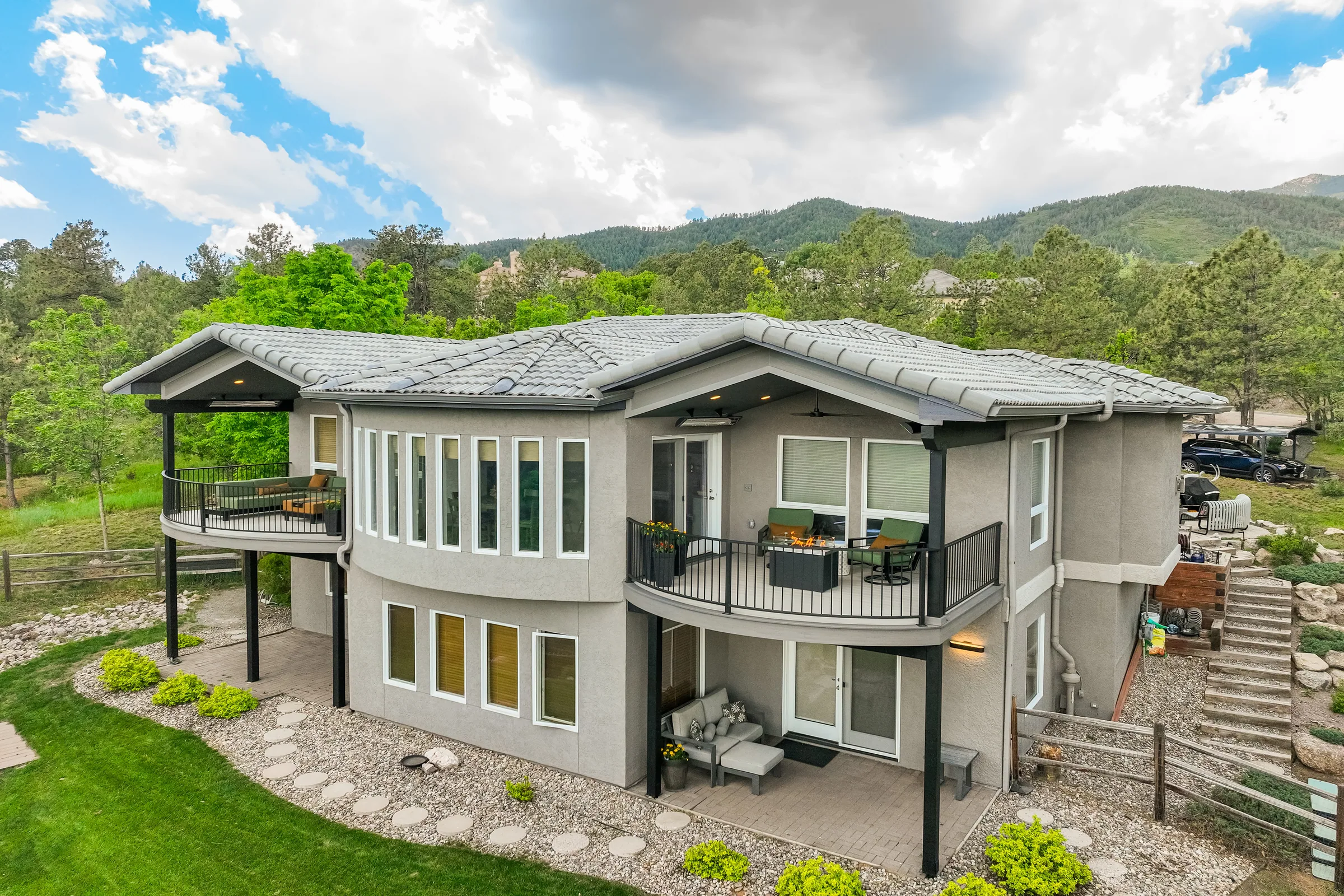
Appendix K · Ordinance 26-18
The Colorado Springs wildfire code, in plain terms
Colorado Springs adopted a new wildfire code on June 30, 2026. It is mapped parcel by parcel, it changed what a deck can be built from, and it can be triggered by a siding job you thought was a repair. Here is what it actually says.
Your neighbor can be in a different risk class than you.
Colorado Springs maps its wildfire code parcel by parcel. Not by neighborhood, not by street, not by how close the trees are. The line runs between houses, and which side of it your lot sits on decides what your deck is allowed to be built from. It is the most misunderstood thing about this code, and it is the first thing we look up.
The map
Is your property in the wildfire zone?
- Unshaded: the code doesn't reach you
- Class 1: no wood decking
- Class 2: fire-rated boards too
Close to 47,000 parcels sit inside one of the two risk classes: 10,652 in Class 1 and 36,352 in Class 2. Everything else is unshaded, and on an unshaded parcel the wildfire code sets no material restriction at all. The city draws it lot by lot, so the only honest answer to "am I in it" is your address. We look yours up before we quote.
Get a quote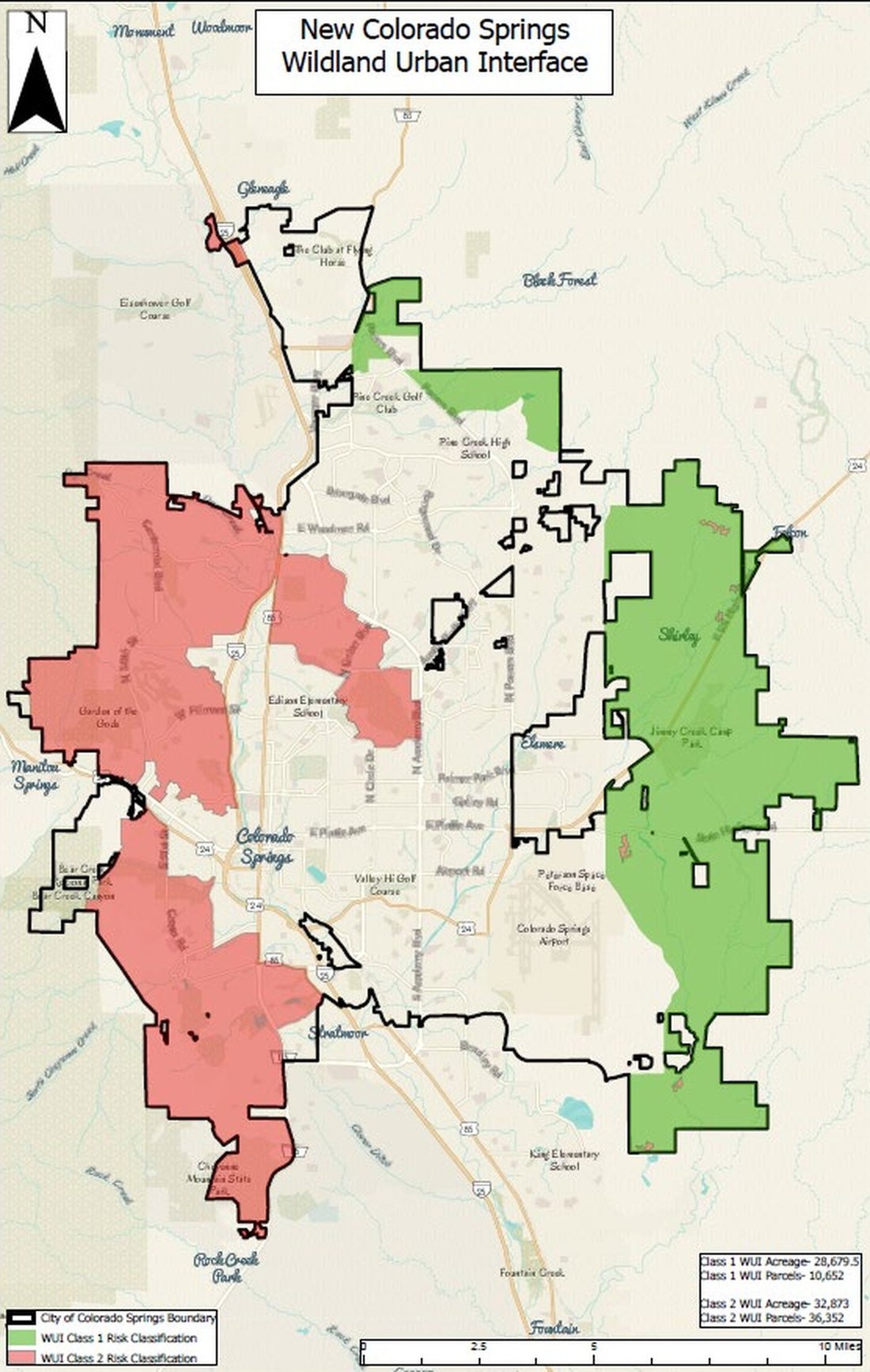
Class 1 and Class 2
Both are the wildfire code. They do not ask for the same things.
This is where most of the confusion lives. People hear "I'm in the WUI" and assume one set of requirements. There are two, and the gap between them is a fire rating.
| Class 1 | Class 2 | |
|---|---|---|
| Where | The newer east side of the city. | The established west side, where risk runs moderate to high. |
| How much | 28,679.5 acres · 10,652 parcels | 32,873 acres · 36,352 parcels |
| Decking surface | Wood is out. Any composite qualifies. | Wood is out, and the boards need a rating of Class B or better on the walking surface. |
| Fire rating | Not required on decking. | Required. This is the whole difference between the two. |
| Sign-off | Residential goes through on an affidavit. | Residential requires inspections. |
How Class 1 and Class 2 differ on location, size, decking surface, fire rating and sign-off.
The short version: Class 1 settles the wood question and stops. Class 2 settles the wood question and then adds a rating on top of it. So when somebody tells you "the WUI needs fire-rated decking", they are describing Class 2. If you are on the east side, they may be describing the wrong half of the city.
The trigger nobody knows about
Replace a quarter of your siding and the whole code arrives.
Section K101.9 of Ordinance 26-18 sets a threshold, and it is the provision that catches people. Replace 25% or more of your siding or roofing, measured net, and the job has to meet Appendix K in full. Not the quarter coming off. The building. A WUI Acknowledgement Form goes in with the permit application. Under the threshold, a repair stays a repair. The trouble is that nobody sets out to replace 24%. "The weather side this year, the rest next year" is two jobs on paper and one threshold in practice, and the place people find that out is at inspection.
- Where the number comes fromK101.9, Ordinance 26-18. Net replacement. You measure what is actually coming off, not the wall area it came from.
Jurisdiction
These classes stop at the city limit.
Class 1 and Class 2 are Colorado Springs' own. They were created under Ordinance 26-18 and drawn on the city's own map. They do not exist in Monument. They do not exist in Black Forest.
That is not the same as saying those places have no wildfire rules. Every jurisdiction writes its own: the incorporated towns, unincorporated El Paso County, and the statewide Colorado Wildfire Resiliency Code on top. Different requirements, different maps, different forms. Being outside Colorado Springs usually means a different code applies, not none.
We build across nine service areas, so the first question on any exterior job is which authority governs the address, rather than which rule we happen to know best.
Does this apply to me
What the code asks for, and what it leaves alone.
Appendix K is narrower than people expect in some places and wider in others. It is worth knowing which is which before you assume a project is affected, or assume it isn't.
The deck
CoveredThe walking surface. Appendix K K105.1 item 8 requires ignition-resistant decking and names composite or metal; wood is not permitted for the surface. If the deck has a projection or an overhang, the horizontal area underneath has to be closed in with material that resists ignition (K105.1 item 3).
Not coveredStructure and railings. The same provision that bars wood from the surface allows it for large structural components and railings, and allows exposed heavy timber or dimensional log for the vertical posts of covered decks and patios.
This has applied to any deck added, modified, altered or rebuilt since June 30, 2023, three years before the risk classes arrived. Re-decking an existing frame counts.
Siding and roofing
CoveredBoth sit inside Appendix K, and both carry the 25% trigger above. Cross it and the whole appendix applies to the job rather than to the part you are replacing.
Not coveredA genuine repair. Work below the threshold does not pull the rest of the code in behind it.
Appendix K was re-adopted in June 2026, so we check the material specification against the current text for your class rather than quoting the version we learned. That matters more here than on decking, where the wording has held.
The ground around the house
CoveredFuels management, section K103. Tree branches may not extend over or under the roof or eaves, and may not come within fifteen feet of a deck, a wood-burning appliance or a chimney (K103.5). Appendix K calls the first thirty feet around a structure the Safety Zone.
Not coveredYour planting scheme. The code sets clearances, not a plant list, and nothing in it stops you having a garden.
Defensible space is usually split into three zones: the immediate zone at 0 to 5 feet, the intermediate zone at 5 to 30, and the expanded zone from 30 to 100. Those names come from wildfire practice and from the fire department's own training material, not from Appendix K, which uses a single Safety Zone: the first thirty feet around a structure. Both are worth following. Only one of them is enforceable here.
Section references are to Appendix K as adopted by the City of Colorado Springs. Nothing here is a substitute for what the building department tells you about your specific parcel, and where the two disagree, they are right and we are not.
Wildfire code compliance, handled
Who does what.
This is a permit problem before it is a building problem, and almost all of it lands on whoever pulls the permit.
That is us.
We do
Look your parcel up and establish its class before anything is drawn. Spec the build to that class. Prepare the WUI Acknowledgement Form and file it alongside the permit application. Book and attend the inspections.
You do
Sign the Acknowledgement Form. That is the list.
Straight answers
Questions we get
Is my house in the Colorado Springs wildfire zone?
Colorado Springs maps its wildland urban interface parcel by parcel, so the answer depends on your specific lot rather than your neighborhood. Two houses on the same street can land in different risk classes. Close to 47,000 parcels sit inside one of the two classes: 10,652 in Class 1 and 36,352 in Class 2. Everything else is unshaded, and on an unshaded parcel the wildfire code sets no material restriction. The city publishes the map, and we look your parcel up before quoting any deck, siding or roofing work.
My neighbor didn't need fire-rated decking. Why do I?
Because Colorado Springs maps its wildfire code parcel by parcel, and the boundary can run between two houses. There are two risk classes and they do not ask for the same thing. Class 1 rules out wood as a decking surface but accepts any composite, with no fire rating required. Class 2 rules out wood and additionally requires a rating on the walking surface of Class B or better. So a neighbor in Class 1, or on an unshaded parcel, can legitimately build something you cannot. It is not an inconsistency in how the code was applied. It is how the map is drawn.
Can I still build a wood deck in Colorado Springs?
Not the walking surface, if your parcel is inside the wildland urban interface. Appendix K, section K105.1 item 8, requires ignition-resistant decking and names composite or metal, stating that wood is not permitted for the decking surface. The same provision does allow wood for large structural components and railings, and allows exposed heavy timber or dimensional log for the vertical support posts of covered decks and patios. Outside the mapped WUI the wildfire code sets no such restriction. This has applied to any deck added, modified, altered or rebuilt since June 30, 2023.
Does replacing my siding trigger the wildfire code?
It can, and this is the provision almost nobody knows about. Under section K101.9 of Ordinance 26-18, replacing 25% or more of your siding or roofing, measured net, triggers full Appendix K compliance for the job, not just for the portion being replaced, and requires a WUI Acknowledgement Form with the permit. Below that threshold a repair stays a repair. The practical catch is that nobody plans to replace 24%: doing the weather side one year and the rest the next is two jobs on paper and one threshold in practice.
What's the difference between Class 1 and Class 2?
Both are inside the Colorado Springs wildland urban interface; they differ in what they require. Class 1 covers the newer east side of the city (10,652 parcels across 28,679.5 acres) and rules out wood as a decking surface while accepting any composite, with no fire rating required. Class 2 covers the established west side (36,352 parcels across 32,873 acres, where risk runs moderate to high) and requires a rated walking surface, Class B or better, on top of the same wood restriction. Sign-off differs too: Class 2 residential work requires inspections, while Class 1 residential goes through on an affidavit.
Does this apply in Monument or Black Forest?
No. Class 1 and Class 2 are the City of Colorado Springs' own risk classes, created under Ordinance 26-18, and they stop at the city limit. Monument, Black Forest, Falcon, Larkspur and unincorporated El Paso County each set their own wildfire requirements, and there is a statewide Colorado Wildfire Resiliency Code as well. Being outside Colorado Springs is not the same as being outside a code. It usually means a different one applies, with a different map and different paperwork. We establish which authority governs your address before quoting.
Who files the paperwork?
We do. On a Colorado Springs WUI project we look your parcel up, spec the build to its risk class, prepare the WUI Acknowledgement Form, and file it alongside the permit application. You sign it. We book and attend the inspections, two on a WUI residential project. Class 2 residential requires those inspections; Class 1 residential is handled by affidavit instead.
Find out which class you're in.
It takes us a minute to look up, and it changes what your project can be built from. Worth knowing before you get quotes, not after.
Rather talk now? 719-370-3325